
To compare Medicare Part D plans effectively, beneficiaries should use the official Medicare Plan Finder tool to input their specific medications and preferred local pharmacies. This process allows you to evaluate the total annual cost by combining monthly premiums, annual deductibles, and drug copayments while verifying that your necessary prescriptions are included on each plan's formulary.
Selecting a Medicare Part D plan often feels like a moving target, especially as local pharmacy networks and formularies shift annually. For many Erie seniors, the frustration lies in a simple truth; yesterday’s optimal coverage may no longer align with tomorrow’s prescriptions. This choice is not merely about selecting the lowest monthly premium. It is a critical financial decision that impacts your long-term retirement stability. Navigating the 2026 landscape requires a strategic approach to analyzing drug tiers, total out-of-pocket costs, and the nuances of the new Medicare Prescription Payment Plan. In this guide, we provide a structured framework to help you evaluate your specific medication needs. You will learn how to leverage the Plan Finder tool effectively, interpret complex formulary structures, and decide whether a standalone plan or an Advantage plan better secures your physical and financial health.
Why Comparing Medicare Part D Plans is Different for 2026
The landscape for prescription drug coverage is undergoing its most significant transformation in decades. If you have kept the same plan for years because it has historically met your needs, 2026 is the year that strategy must change. The most impactful update for the coming year is the new $2,100 annual out of pocket maximum. This cap represents a firm limit on what you will pay for covered prescriptions at the pharmacy counter, providing a level of financial predictability that was previously unavailable.
In years past, Erie seniors often navigated the complex "donut hole" or faced unlimited spending through a 5% coinsurance requirement during the catastrophic coverage phase. These older structures meant that costs could climb indefinitely for those requiring high-cost specialty medications. For 2026, the system is streamlined; once your spending reaches $2,100, your plan covers 100% of the cost for the remainder of the calendar year.
While this cap is a benefit for many, it requires insurance carriers to completely redesign their offerings to account for the new spending limits. To manage their own costs, companies are aggressively adjusting their formularies, changing drug tier assignments, and recalculating monthly premiums. The national base beneficiary premium for 2026 is set at $38.99, but actual costs for plans available in Pennsylvania will fluctuate based on these internal changes.
Because of these structural shifts, a plan that was cost-effective last year might become one of the most expensive options for your specific medication list in 2026. Taking the time to compare Medicare Part D plans is essential to ensure your drugs remain on the plan's list of covered items. Our independent insurance advisors suggest starting this review early. If you find the new rules confusing, you can contact our Erie office for personalized Medicare guidance tailored to our local community.
Step 1: Gather Your Current Medication List and Pharmacy Preferences

Before you compare Medicare Part D plans, you must create a comprehensive inventory of your current prescriptions. Accuracy is vital because even a small difference in dosage can shift a medication into a different cost tier. Gather your pill bottles and write down the exact drug name, the dosage strength, such as 20mg or 50mcg, and the frequency of use. You should also note if you prefer 30-day or 90-day refills, as many plans offer specialized pricing for larger quantities or mail-order services.
Pharmacy choice is the second half of the comparison equation. Medicare plans typically categorize pharmacies as either preferred or standard. Using a preferred pharmacy can result in significantly lower copays for the exact same medication. In Erie County, major retailers like Wegmans, Giant Eagle, and CVS often participate in these preferred networks, but every plan is different.
If you value the personalized service of a local independent pharmacy, you need to verify if your plan treats them as a standard or preferred provider. Choosing a plan that lacks a preferred relationship with your neighborhood pharmacy could lead to higher costs at the register. If you find this data entry overwhelming, our independent insurance advisors can assist in organizing your list. You can also contact our Erie office for personalized Medicare guidance to ensure your preferred local pharmacy remains a cost-effective option for 2026.
Understanding the Five Tiers of a Drug Formulary
Once you have your medication list and pharmacy preferences identified, you must look at how each plan categorizes those drugs. Every plan uses a formulary, which is essentially a catalog of covered medications organized into tiers. These tiers determine your share of the cost. A common mistake we see in our Erie office is selecting a plan based solely on the monthly premium while ignoring how a specific medication is tiered. A budget plan with a low premium might place your chronic medication in Tier 4, costing you hundreds more over the year than a plan with a higher premium that classifies the same drug in Tier 2.
Understanding the hierarchy is essential for an accurate comparison:
Tier | Category | Typical Cost Structure |
|---|---|---|
Tier 1 | Preferred Generics | Lowest copay; often $0 at preferred local pharmacies. |
Tier 2 | Generics | Low copay; covers common bioequivalent medications. |
Tier 3 | Preferred Brands | Moderate copay; name-brand drugs with no generic equivalent. |
Tier 4 | Non-Preferred Drugs | High copay or coinsurance; often requires prior authorization. |
Tier 5 | Specialty | Highest cost; usually 25% to 33% coinsurance for complex treatments. |
Higher tiers often require you to meet the annual deductible, which can reach $615 in 2026, before the plan pays anything. Lower tiers sometimes waive this deductible, allowing for immediate coverage from your first fill of the year. When you compare Medicare Part D plans, look closely at these tier assignments. If your medications fall into Tiers 4 or 5, your choice of plan becomes significantly more consequential for your monthly budget. Our independent insurance advisors can help you run these numbers to avoid surprises at the pharmacy. If you are unsure which tier your prescriptions fall under, contact our Erie office for personalized Medicare guidance.
The Total Cost Calculation: Beyond the Monthly Premium
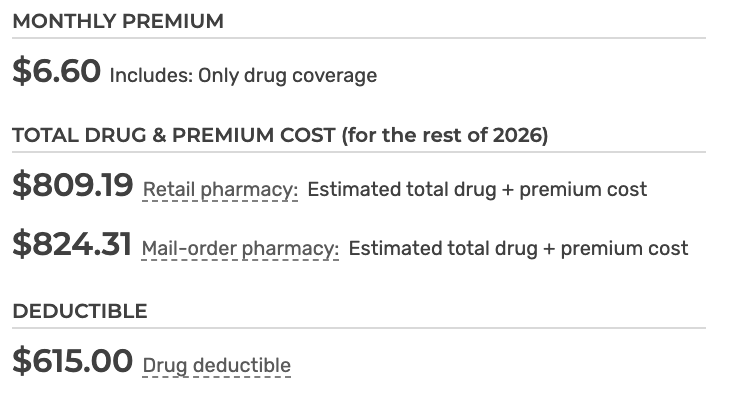
Many people shopping for coverage focus exclusively on the monthly premium, assuming the lowest sticker price represents the best deal. However, when you compare Medicare Part D plans, the premium is often the least significant portion of your financial commitment. A low-premium plan may simply shift the cost burden to a higher deductible or more expensive copays for the specific medications you take.
To see the true picture, you must calculate the total annual out of pocket cost. For 2026, the maximum allowed deductible is $615. Many plans require you to pay this full amount before they begin sharing the cost for anything beyond Tier 1 or Tier 2 generics. If your medications fall into higher tiers, you will likely pay that $615 in full during your first few trips to the pharmacy in January or February.
Use this formula to determine your real expenses: - Annual Premiums: Monthly premium amount multiplied by 12. - The Deductible: The plan's specific deductible, which can range from $0 to the $615 limit. - Copays and Coinsurance: The estimated cost of all your medications for the remainder of the year after the deductible is met.
When our independent insurance advisors review options with clients, we prioritize the "Total Estimated Annual Cost" figure. This number aggregates every expense to show what you will actually spend by December 31st. Relying on this figure helps you avoid plans that look affordable on paper but become expensive at the pharmacy counter. If you need help running these calculations for your specific medication list, you can contact our Erie office for personalized Medicare guidance to ensure your 2026 budget remains predictable.
Comparing PDP vs. MAPD: Which Path is Right for You?
After you have calculated your potential expenses, you must decide which delivery system best fits your overall healthcare strategy. In Erie County, you generally choose between a stand-alone Prescription Drug Plan (PDP) or a Medicare Advantage Prescription Drug plan (MAPD).
A stand-alone PDP is the standard choice for residents who prefer Original Medicare paired with a Medigap policy. These plans offer the greatest flexibility, allowing you to use almost any pharmacy in the region that accepts the plan's network without worrying about hospital or doctor network restrictions. However, a PDP requires its own monthly premium, which is an additional cost alongside your Part B and Medigap payments.
Medicare Advantage plans (MAPD) bundle your medical and drug coverage into one package. In many Erie County MAPD options, the drug coverage is included for a $0 additional premium beyond the base plan cost. The trade-off is often a more restrictive pharmacy network. If you move to an MAPD, you must ensure your local Erie pharmacy is listed as a preferred provider to keep your copays low.
Feature | Stand-alone PDP | Medicare Advantage (MAPD) |
|---|---|---|
Primary Partner | Original Medicare & Medigap | All-in-one private plan |
Premiums | Separate monthly bill | Often $0 or bundled |
Pharmacy Network | Generally broader flexibility | Often tighter, localized networks |
Administration | Managed separately from medical | Managed by the same carrier |
Our independent insurance advisors often find that clients who travel frequently prefer the portability of PDPs, whereas those looking for simplified billing lean toward MAPDs. To see which structure helps you best compare Medicare Part D plans, you can contact our Erie office for personalized Medicare guidance tailored to your specific pharmacy needs.
The New Medicare Prescription Payment Plan (M3P) Explained
As you compare Medicare Part D plans for the upcoming year, you will encounter a brand new feature called the Medicare Prescription Payment Plan (M3P). This is not a new type of insurance coverage or a separate health plan. Instead, it is a payment arrangement provided by your insurance carrier that allows you to spread your out of pocket prescription costs into monthly installments throughout the calendar year.
This program is designed specifically to help with cash flow, which is particularly beneficial for Erie residents who take high cost medications. Under the standard system, you might pay your full $615 deductible during your first pharmacy visit in January. With M3P, you pay $0 at the pharmacy counter, and the plan bills you a calculated monthly amount later. This prevents the heavy financial burden often felt at the start of a new plan year.
It is vital to understand that this option does not lower the total amount you owe; it only changes when you pay it. Participation is voluntary, and you must opt in through your specific plan provider. While it prevents a massive bill in January, your monthly payments may fluctuate if you add new prescriptions mid year. Our independent insurance advisors often recommend this for individuals who struggle with the sticker shock of early year drug costs. If you are unsure if this billing method benefits your specific financial situation, contact our Erie office for personalized Medicare guidance before the enrollment deadline.
How to Use the Medicare Plan Finder Tool Effectively

The Medicare.gov Plan Finder tool provides a direct way to compare Medicare Part D plans, provided you input accurate data. Start by entering your specific Erie ZIP code, such as 16501 or 16505, to filter for plans available in our region. After entering your medications, the tool will display the "Total Yearly Drug and Premium Cost," which is the most important metric for your budget.
Look closely at the comparison between "Mail Order" and "Retail" pricing. In Pennsylvania, mail order often offers lower copays for 90 day supplies, but some plans have "preferred" status with local Erie retail pharmacies that offer competitive rates. You should also evaluate the Star Ratings. These are not merely reviews; they represent a plan’s performance in critical areas like customer service responsiveness and pharmacy billing accuracy. A high rating often indicates fewer headaches when dealing with claims or coverage determinations.
If the digital tool feels overwhelming, independent insurance advisors can help you interpret the results. You can contact our Erie office for personalized Medicare guidance to ensure your 2026 selection provides the local support and price stability you require.
Selecting the right Medicare Part D plan involves more than just looking at the monthly premium. It requires a detailed review of your current prescriptions and local pharmacy networks to ensure you receive the best value. While this guide provides a solid foundation for your research, navigating the specific details of coverage can often feel complicated. If you want expert help tailored to your unique health needs, you can learn more about our approach to serving the Erie community. We are here to simplify the process and ensure you make a confident decision for your future.